How to Prevent Limescale in Hard Water Areas (Without Harsh Chemicals)
In hard water areas, limescale is not a sign of poor cleaning. It is a result of mineral-rich water evaporating on surfaces. If you constantly clean your shower but still see white streaks, cloudy glass or chalky residue, the issue is not effort — it is evaporation.
This guide explains how to prevent limescale permanently, why shower glass gets dirty again, and how a simple daily drying method can replace aggressive chemical routines.
Quick Definition
Limescale forms when hard water evaporates and leaves behind calcium and magnesium deposits that bond to glass, tiles and chrome surfaces.
Quick Answer
To prevent limescale in hard water areas, remove water from surfaces immediately after shower use. Drying stops mineral bonding before it begins, reducing the need for repeated scrubbing.
Why Hard Water Causes Streaks and Cloudy Glass
Hard water contains dissolved minerals, primarily calcium and magnesium. These minerals are invisible while dissolved in water. However, when water evaporates, the minerals remain behind and form visible deposits.
What Happens After Every Shower?
- Water droplets remain on glass and tiles
- Evaporation begins within minutes
- Minerals crystallise on the surface
- Repeated cycles create buildup
This is why shower glass often looks dirty again within 24–48 hours of cleaning.
Quick Answer
Shower glass gets dirty again because microdroplets dry into mineral residue. Cleaning removes existing deposits. Drying prevents new ones from forming.
The Evaporation Problem: Cleaning vs Prevention
Most routines focus on removing limescale after it appears. Prevention works differently.
| Cleaning | Prevention |
| Removes visible scale | Stops mineral bonding |
| Often requires chemicals | Works with water-only routine |
| Temporary clarity | Long-term surface protection |
Cleaning removes dirt. Drying prevents mineral damage.
The Science of Limescale Prevention
Microdroplets
After a shower, thousands of microscopic droplets remain on surfaces. These droplets contain dissolved minerals.
Evaporation Process
Water evaporates. Minerals do not. They crystallise and adhere to glass.
Capillary Absorption
High-density microfibre cloths use capillary action to draw water deep into the fibre structure, removing moisture more completely than wiping with standard fabric.
Fibre Density (GSM)
Premium drying cloths use higher GSM (grams per square metre) fabric, allowing greater water absorption capacity. Higher density reduces leftover moisture and improves streak-free results.
Quick Answer
Limescale prevention works by removing water before evaporation occurs. Without evaporation, mineral deposits cannot form.
Daily Limescale Prevention Routine (60 Seconds)
Step 1: Shower as normal
No changes required during use.
Step 2: Dry immediately after use
Use a high-absorbency bathroom drying cloth to wipe glass, tiles and chrome.
Step 3: Air dry the cloth
Allow it to dry between uses.
Quick Answer
Dry your shower while the glass is still warm. One pass removes microdroplets and prevents streak-free glass from becoming cloudy again.
See the Impact: Prevention vs Buildup

Before: Mineral deposits from repeated evaporation cycles.
After: Clear glass maintained by daily drying routine.
What Is a Bathroom Drying Cloth?
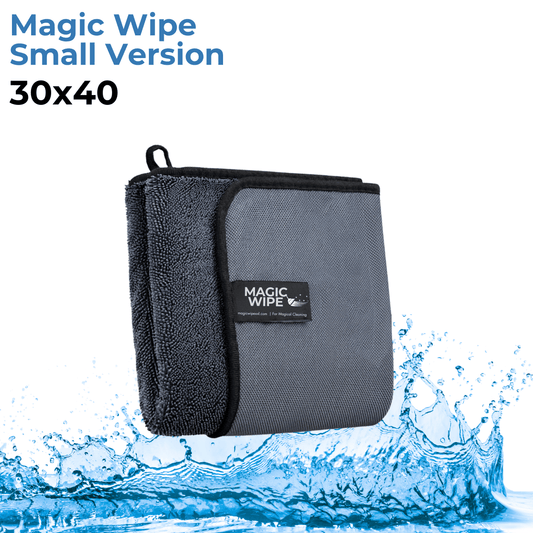
A bathroom drying cloth is a reusable, ultra-absorbent microfibre cloth designed to remove water immediately after shower use, preventing streaks and limescale formation.
It is not primarily a scrubbing tool. It is a preventive moisture-control tool.

Example: Magicwipe XXL Drying Cloth
Why a Drying Cloth Replaces a Squeegee
| Feature | Drying Cloth | Squeegee |
| Absorbs water | Yes | No (pushes water) |
| Removes microdroplets | High | Limited |
| Prevents mineral residue | Yes | Partially |
A squeegee pushes water downward. A drying cloth absorbs it entirely.
Magicwipe vs Magic Eraser – Important Clarification
Magicwipe™ is a reusable microfibre drying cloth.
It is not:
- Melamine foam
- An abrasive sponge
- A chemical cleaning product
Magic Eraser products use melamine foam for scrubbing stains. They are abrasive and not designed for daily water absorption.
Quick Answer
Magicwipe prevents limescale by removing water. Magic Eraser removes stains by abrasion. They are completely different tools.
Water-Only Cleaning Method
When surfaces are kept dry daily, heavy chemical descalers become less necessary. This supports a water-only maintenance routine and reduces repeated exposure to harsh products.
Learn more about moisture prevention on the Magicwipe homepage.
Frequently Asked Questions
1. Can you prevent limescale permanently?
Yes, by removing water immediately after use to stop evaporation cycles.
2. Why does limescale keep coming back?
Because water is left to evaporate on surfaces.
3. Does drying work better than scrubbing?
Drying prevents new deposits. Scrubbing removes existing ones.
4. Is this suitable for hard water areas?
Yes. Hard water areas benefit most from daily drying routines.
5. Do you need chemicals for prevention?
No. Prevention focuses on moisture removal, not chemical reaction.
6. How long does drying take?
Typically under 60 seconds.
7. Can it be used on tiles and chrome?
Yes. Drying cloths work on glass, tiles, mirrors and metal surfaces.
8. Is microfibre safe for glass?
Yes. Non-abrasive microfibre is safe for delicate surfaces.
Bottom Line
Limescale is an evaporation issue, not a cleaning failure.
In hard water areas, drying your shower after every use is the most effective way to prevent mineral buildup. A bathroom drying cloth absorbs water before it evaporates, reducing streaks, cloudy glass and repeated scrubbing.